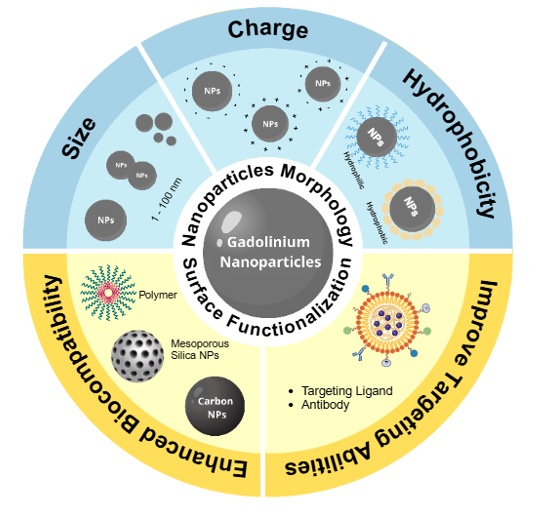


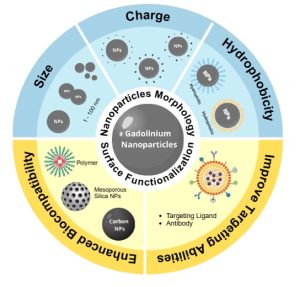
Gadolinium nanoparticles (GdNPs) are nanomaterials with great potential to be applied as MRI contrast agents. GdNPs have been widely explored in recent years as a T1 contrast agent with high performance due to the large relaxivity value (r1) compared to commercial Gd-based contrast agents. However, the major limitations of using these materials for biomedical applications are their cytotoxic effects and cellular uptake efficiency. The morphology of GdNPs, such as size, charge, and surface play an important role in affecting biocompatibility and cellular uptake. For instance, by modifying the surface of nanoparticles, the physical-chemical properties can be altered, leading to improvement in biocompatibility and cellular uptake. Various molecules have the potential to be functionalized on GdNPs, but it is essential to select those that can effectively enhance their abilities. Therefore, this review aims to discuss several studies on the effect of morphology and surface modification of GdNPs to improve biocompatibility and cellular uptake.
Contributes to the following SDGs:
Access to document: https://doi.org/10.48048/tis.2025.9330
By Fauzia et al.
Department of Chemistry, Faculty of Mathematics and Natural Sciences, Universitas Padjadjaran, Sumedang 45363, Indonesia.
Study Center of Sensor and Green Chemistry, Faculty of Mathematics and Natural Sciences, Universitas Padjadjaran, Bandung 40132, Indonesia.
#UnpadResearch #Goodhealthandwellbeing #SDGs3 #Gadolinium #ContrastAgents
01/Kim/2025