
Bandung — A research team from Universitas Padjadjaran has successfully mapped tuberculosis (TB) hotspots across West Java using advanced clustering methods, offering a powerful tool to support Indonesia’s fight against one of its most persistent public health challenges. Published in the international journal Communications in Mathematical Biology and Neuroscience (2025), the study highlights how poor sanitation and high population density contribute significantly to TB prevalence, aligning directly with Sustainable Development Goals (SDG) 3: Good Health and Well-being and SDG 6: Clean Water and Sanitation.
Why This Matters
Indonesia ranks second in the world for TB cases, with West Java leading as the province with the highest incidence. In 2023 alone, more than 211,000 TB cases were reported in West Java, a figure exacerbated by dense urban populations and uneven access to sanitation. Identifying high-risk areas is crucial for targeted interventions and efficient resource allocation.
How the Study Was Conducted
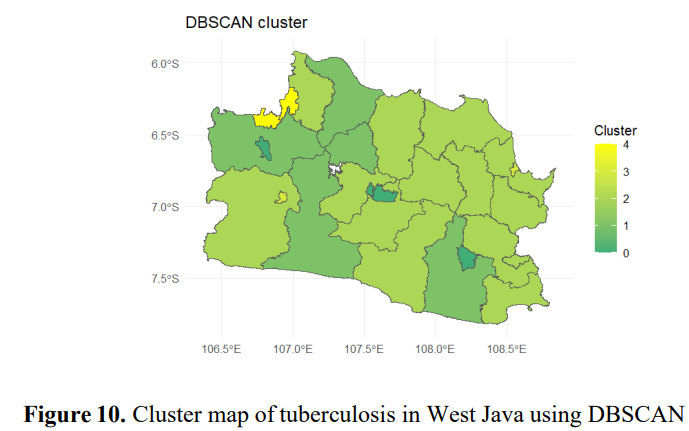
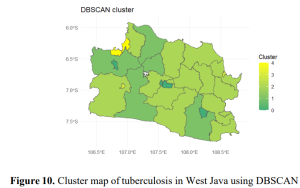
Researchers from the Department of Statistics, Universitas Padjadjaran analyzed secondary data from the West Java Statistics Agency and Open Data Jabar. Using two popular clustering algorithms—K-Means and DBSCAN—the team grouped districts and cities based on TB prevalence, sanitation levels, and population density.
The analysis found that the K-Means algorithm performed better, producing five clear clusters that reflect the varying severity of TB risk across regions.
Key Findings
- Cirebon City reported the highest TB prevalence, at 1.194 cases per 100,000 population.
- Tasikmalaya City recorded the lowest sanitation coverage, at only 29,66%.
- Areas with high population density, such as Bandung City, were more prone to TB spread.
- Clusters with both poor sanitation and high TB rates emerged as the most urgent targets for intervention.
“These results demonstrate that data-driven clustering methods can reveal patterns that traditional statistics may overlook, allowing policymakers to prioritize high-risk areas more effectively,” explained the research team.
Implications for Policy and SDGs
The study’s insights offer valuable guidance for the West Java government and national TB control programs. By pinpointing districts with overlapping vulnerabilities—such as poor sanitation and high TB incidence—authorities can design more precise, cost-effective, and impactful interventions.
This evidence-based approach supports Indonesia’s commitment to the United Nations Sustainable Development Goals (SDGs), particularly:
- SDG 3 (Good Health and Well-being): strengthening efforts to end TB as a major health threat.
- SDG 6 (Clean Water and Sanitation): ensuring equitable access to clean water and improved sanitation as a means to curb infectious diseases.
A Step Toward Healthier Communities
With TB still a leading cause of death in Indonesia, this study underscores the urgency of combining statistical innovation with public health strategies. By mapping risks at the local level, Unpad researchers provide a pathway toward healthier, more resilient communities—one that aligns with global goals while addressing urgent local needs.
Source: https://scik.org/index.php/cmbn/article/view/9039
#UnpadResearch #Tubercolosis #RiskMapping
01_Stat_2025