
By Chemical Analysis and Separation Laboratory, Department of Chemistry, Faculty of Mathematics and Natural Sciences, Universitas Padjadjaran
Sumedang, Wednesday, 7 August 2024
Chemistry in Everyday Life: Interactive Chemistry Experiments with Commonly Used Materials
1.1. Background
Chemistry is the study of the properties, composition, and changes of matter.
An understanding of chemistry is crucial because almost every aspect of daily life involves chemical processes, from cooking food and cleaning the house to maintaining health. Many of the products we use, from food and medicines to cleaning products, involve complex chemical reactions. By understanding the basics of chemistry, we can make wiser and safer decisions when using these products and gain a greater appreciation for the natural phenomena that occur around us.
The theme “Chemistry in Everyday Life” was chosen to provide students with an understanding of how chemistry relates to their lives. By using real-world examples and interactive experiments, students can see firsthand how chemical concepts are applied in everyday life. This theme also aims to dispel the perception that chemistry is a difficult subject and far from everyday reality.
The target participants for this Community Service (PkM) activity are students of Madrasah Aliyah Darul Hufadz Cipacing. The selection of these target participants was based on the need to introduce and motivate students at the senior high school level about the importance of science, particularly chemistry. Students at this level are at a critical stage in determining their interests and future careers. Therefore, introducing chemistry through simple experiments and materials easily found around them is expected to foster curiosity, interest, and a deeper understanding of chemistry.
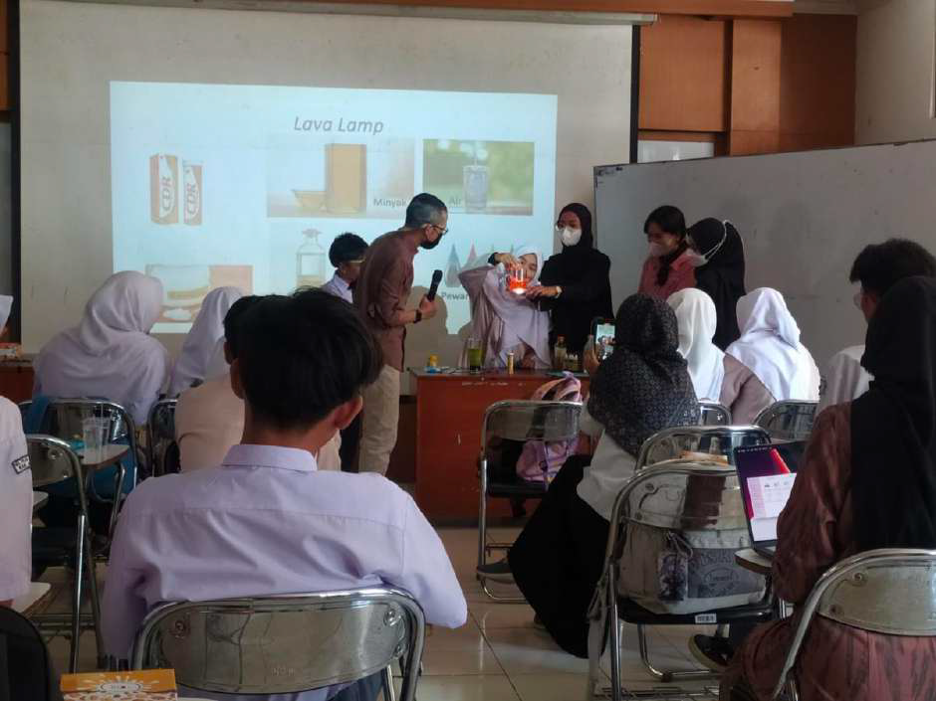
By involving students in interactive experiments such as lava lamps, rainbows in a glass, and magic milk, students can learn in a fun and interactive way.
The use of simple materials such as vinegar, baking soda, milk, soap, and effervescent liquids also demonstrates that chemistry experiments do not always require sophisticated laboratory equipment. This activity is also designed to improve students’ practical skills, facilitate understanding of basic chemical concepts, and demonstrate the relevance of chemistry in their daily lives.
1.2. Activity Objectives
- To introduce basic chemical concepts through interactive experiments.
- To increase students’ interest and understanding of chemistry.
- To teach practical skills in conducting simple experiments.
1.3. Activity Benefits
- To provide students with hands-on experience in conducting chemical experiments.
- To foster students’ curiosity and analytical skills.
- To help students understand the applications of chemistry in everyday life.
2.1. Preparing Materials in the Form of PowerPoint Slides
The first step in implementing community service is preparing the materials to be presented to Madrasah Aliyah students. This material is presented in the form of PowerPoint slides containing several interactive chemistry experiments using chemicals easily found in everyday life. The chemistry experiments demonstrated include a rainbow in a glass, magic milk, and a lava lamp.
The rainbow in a glass experiment begins with the preparation of sugar solutions of various concentrations (e.g., 10%, 20%, 30%). Next, food coloring of a different color is added to each solution. Each layer can be carefully stacked in the glass to form a rainbow due to the differences in density.
To conduct the magic milk experiment, first prepare a flat plate and pour milk into it until it forms an even layer on the bottom of the plate. Use high-fat milk (such as full-fat milk) because the fat in the milk will play a significant role in this experiment. Then, drop three different colored food colorings into the milk. Place the drops of dye at various points in the plate, but not too close to each other to prevent the colors from mixing immediately. Next, take a stick and dip the tip into the liquid soap. Once the stick is dipped in the soap, use the stick to touch one of the drops of dye in the milk. Don’t stir; simply touch it and observe what happens. Repeat this process with the other drops of dye using the same stick tip or adding more soap if necessary.
To conduct the effervescent lava lamp experiment, first prepare a tall, transparent glass. Fill one-third of the glass with water, then add a few drops of food coloring of your choice. Next, pour cooking oil into the container until it is almost full, leaving a little space at the top. Let the oil and water mixture sit for a few minutes until the oil separates completely and the oil layer sits on top of the water layer. Take an effervescent tablet and place it in the container.
For the second version of the lava lamp experiment, prepare the same transparent container as before. Fill it about two-thirds full with cooking oil. In a small bowl, mix a small amount of water with food coloring until the colors are evenly mixed. Add a few teaspoons of baking soda to the colored water mixture and stir well. Then, pour the colored water and baking soda mixture into the container containing the cooking oil. Slowly add acetic acid (vinegar) to the container.
2.2. Organizing Interactive Activities and Practicals
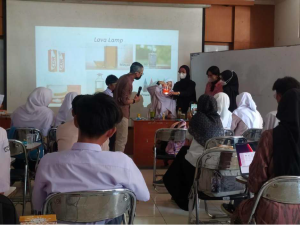
This community service activity was held at the Chemistry Department, Faculty of Mathematics and Natural Sciences, Padjadjaran University (Unpad). Selected high school students were invited to attend. Students were encouraged to participate in interactive experiments with the promise of winning prizes.
2.3. Data Collection and Evaluation of Community Service Results
In the final stage, data was collected on students’ knowledge and awareness before and after the community service activity. The results of this data collection will be used to evaluate the effectiveness of the community service activity and the extent to which students’ knowledge and awareness have increased after participating. This evaluation will serve as a basis for identifying the success of this community service and providing input for improving future activities.
Contributes to the following SDGs:
#SDGs2 #SDGs4 #SDGs8 #SDGs11
28/Kim/2025