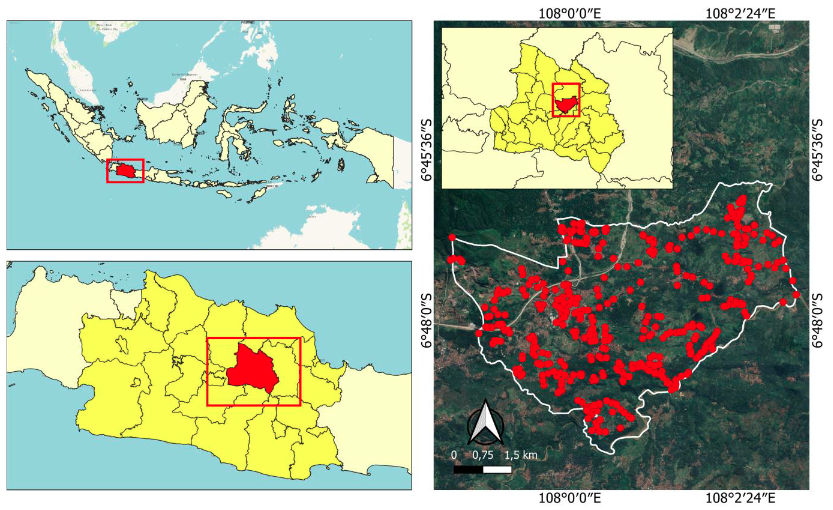

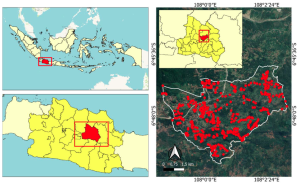
Sumedang, Indonesia — A new study published in Biodiversitas reveals how human-modified landscapes significantly influence bird diversity in Paseh Sub-district, Sumedang, West Java. Conducted by researchers from Universitas Padjadjaran and Universitas Diponegoro, the study highlights the complex relationship between land-use change, habitat fragmentation, and avian biodiversity.
The research assessed how variations in land use—settlements, rice fields, mixed gardens, forests, and other habitats—affect bird diversity. Using the point count method across 450 sites and landscape analysis with Fragstats software, the team recorded 74 bird species from 32 families, totaling 3,115 individuals.
Findings show that bird diversity varied by land-use type: mixed gardens (H’ = 3.13) hosted the highest diversity, followed by rice fields (H’ = 2.65), while settlements showed the lowest (H’ = 1.47). The Eurasian tree sparrow (Passer montanus) was the most abundant, comprising 38.1% of all individuals. Importantly, landscape factors such as patch size, edge length, and habitat heterogeneity were strongly correlated with bird diversity.
Six bird species recorded in the area are legally protected in Indonesia, including the Black eagle (Ictinaetus malaiensis) and Javanese woodcock (Scolopax nigrorufa). Two species were classified as vulnerable under the IUCN Red List, underscoring the conservation value of this landscape.
The Importance
Birds are not only indicators of ecosystem health but also providers of vital services such as pollination and natural pest control. The study demonstrates that human activities like toll road construction, agricultural expansion, and urban growth can both threaten and reshape bird habitats.
Interestingly, some species have adapted to fragmented and modified environments, while others remain vulnerable to habitat loss. This duality emphasizes the urgent need for sustainable land management that balances development with biodiversity protection.
By mapping how landscape structure impacts bird distribution, the research provides crucial data to guide policymakers, conservationists, and local communities in designing land-use strategies that safeguard ecological balance.
Connection to the Sustainable Development Goals (SDGs)
The study directly contributes to SDG 15: Life on Land, which seeks to protect, restore, and promote sustainable use of terrestrial ecosystems. By showing the link between land-use changes and bird biodiversity, the research highlights the importance of integrating ecological considerations into regional development planning.
Protecting avian diversity not only conserves wildlife but also ensures ecosystem resilience, food security, and sustainable rural livelihoods.
Looking Ahead
The authors call for better habitat conservation policies, integration of biodiversity-friendly practices in agriculture, and the creation of ecological corridors to reduce fragmentation. As Sumedang and other regions in Indonesia continue to develop, these findings serve as a timely reminder that economic growth and biodiversity conservation must go hand in hand.
In the words of the researchers, maintaining bird diversity in human-modified landscapes is not just about saving species—it is about ensuring the long-term sustainability of ecosystems that people depend on every day.
06/Bio/2025