

A Spatial Model to Analyze Stunting in Java Island
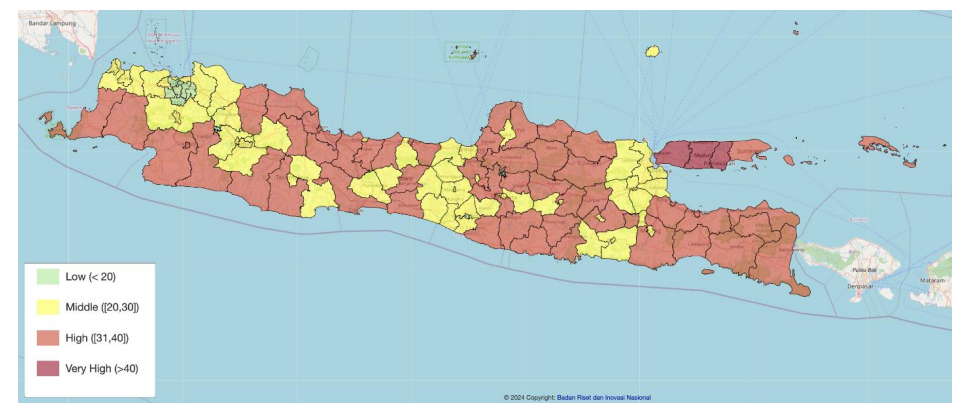



A team of lecturers and researchers from Universitas Padjadjaran, in collaboration with partners, has published their latest study in Communications in Mathematical Biology and Neuroscience. The research introduces the use of the Expanded Spatial Durbin Model (ESDM) to analyze stunting prevalence in Java Island by considering exogenous factors with spatial dependencies.
Stunting is a chronic health issue that severely affects children’s physical and cognitive development, particularly in developing countries such as Indonesia. This study highlights the importance of addressing spatial dependencies not only in the response variable (stunting prevalence) but also in exogenous variables such as malnutrition prevalence and the Human Development Index (HDI).
By applying an inverse distance weight matrix using the Euclidean method and employing the Moran Index to detect autocorrelation, the researchers found that malnutrition has a much stronger effect on stunting compared to HDI. These findings reaffirm that nutritional factors remain the key determinant in reducing stunting rates in densely populated regions like Java Island.
The study also aligns with the United Nations Sustainable Development Goals (SDGs), specifically:
- SDG 2 (Zero Hunger): reducing malnutrition to improve child health.
- SDG 3 (Good Health and Well-Being): ensuring healthy growth for children through data-driven interventions.
- SDG 10 (Reduced Inequalities): addressing health disparities across regions with spatial approaches.
With its advanced quantitative and spatial modeling approach, this research is expected to support governments and policymakers in designing more targeted intervention strategies to combat stunting in Indonesia.
Source: https://www.scopus.com/record/display.url?eid=2-s2.0-105005963174&origin=resultslist
18/Stat/2025