

Adsorption evaluation of linear alkylbenzene sulfonate on magadiite-magnetite and carbon-magnetite from rice husk ash
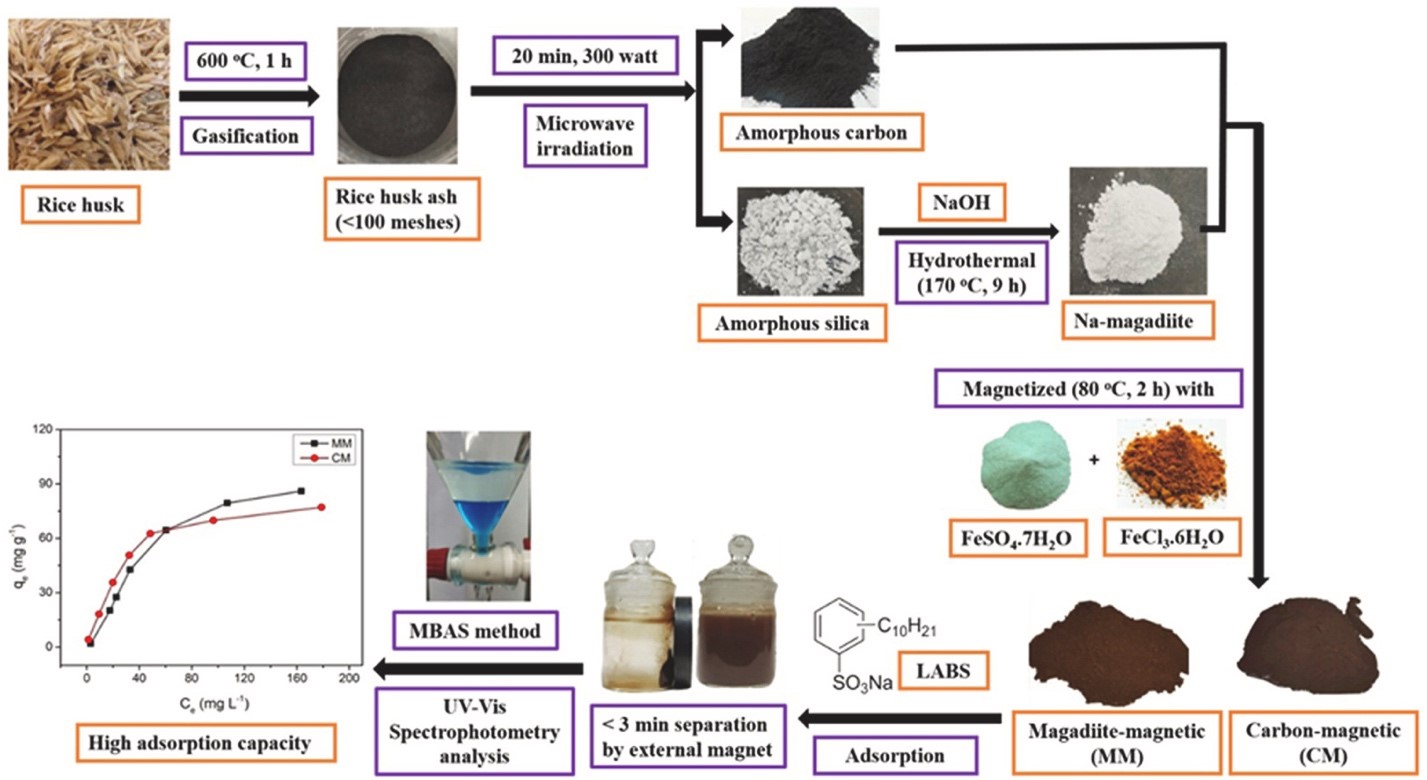
The presence of surfactant waste in the aquatic environment contributes to environmental problems. In this study, the adsorption that uses magadiite and carbon from rice husk ash via the microwave irradiation method and is composited with magnetite was proposed. The composite magadiite-magnetite (MM) and carbon-magnetite (CM) were obtained by co-precipitation methods by intercalation and impregnation. MM and CM were evaluated as adsorbents for the removal of the anionic surfactant linear alkylbenzene sulfonate (LABS). The obtained material was characterized by X-ray diffraction (XRD), Fourier-transform infrared (FTIR), scanning electron microscope-energy dispersive X-ray spectroscopy (SEM-EDX), thermal gravimetric analysis (TGA), N2 adsorption by Brunauer-Emmet-Teller (BET) method, and vibrating sample magnetometer (VSM). The influence of contact time, initial concentration, temperature, pH, and adsorbent dose on the adsorption process was investigated. The adsorption kinetics of LABS onto MM and CM followed the pseudo-second-order model and the equilibrium data fitted well to the monolayer Langmuir model as confirmed by the calculated values of R2. The adsorption capacity for LABS on MM and CM is 129.00 and 91.77 mg g−1, respectively. The thermodynamic study exhibited that those adsorptions occurred spontaneously with a predominance of chemisorption. MM and CM could be utilized as effective adsorbents with retrieval ability for removing anionic surfactant pollutants in aquatic environments.
Contributes to the following SDGs:
#SDGs14
Access to document: https://doi.org/10.1016/j.cscee.2025.101224
By Yuliana et al.
*Correspondence author: [email protected]
Department of Chemistry, Faculty of Mathematics and Natural Sciences, Universitas Padjadjaran, Sumedang 45363, Indonesia.
#UnpadResearch #LifeBelowWater #SDGs14 #Surfactant #CarbonMagnetite
16/Kim/2025