


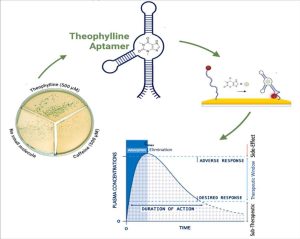
Theophylline is a widely used bronchodilator for treating asthma-related symptoms like shortness of breath and chest tightness. However, its narrow therapeutic plasma range (20–200 μM) necessitates careful monitoring of blood levels to prevent toxicity. Various clinical laboratory techniques have been developed for detecting theophylline, including spectroscopy, high-performance liquid chromatography (HPLC), fluorescence polarization immunoassay, and radioimmunoassay. Despite their utility, these methods are limited by complex sample preparation, long processing times, large sample volumes, and high costs. Aptamer-based biosensors have emerged as a promising alternative, offering superior selectivity and specificity compared to conventional methods. This review evaluates the performance of aptamer-based sensors in terms of sensitivity, specificity, and limit of detection, comparing them to traditional techniques. Recent studies demonstrate the advantages of aptamer-based sensors, including their simplicity, rapid response time, and cost-effectiveness, which make them ideal for point-of-care applications. The review also explores the methodologies used in aptamer-based detection, highlighting key innovations and advances in the field. Findings from the literature show how aptamer-based sensors enhance the monitoring of theophylline levels, overcoming the limitations of traditional techniques. This is the first review dedicated to discussing aptamer-based techniques for theophylline monitoring, addressing a gap in current literature.
Contributes to the following SDGs:
Access to document: https://doi.org/10.1016/j.cca.2025.120200
By Hartati et al.
Department of Chemistry, Faculty of Mathematics and Natural Sciences, Universitas Padjadjaran, Sumedang 45363, Indonesia.
Study Center of Sensor and Green Chemistry, Faculty of Mathematics and Natural Sciences, Universitas Padjadjaran, Bandung 40132, Indonesia.
#UnpadResearch #Goodhealthandwellbeing #SDGs3 #ElectrochemicalSensors #MolecularlyImprintedPolymers #DiabetesMellitus
03/Kim/2025