

An enhanced efficacy of antibacterial wound dressings impregnated with bacterial cellulose-based microencapsulated lime (Citrus aurantiifolia) essential oil
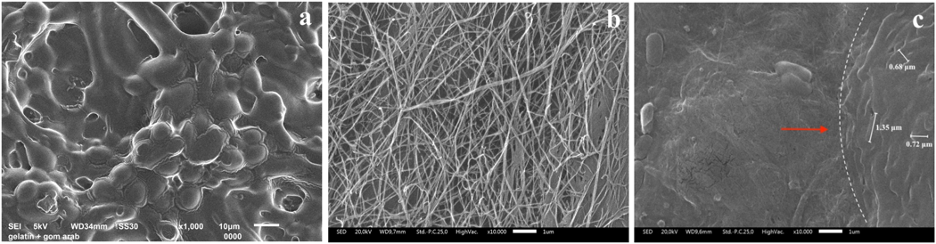

Lime peel essential oil (LPO) exhibits promising antibacterial properties, yet its inherent instability limits its practical applications, necessitating effective encapsulation strategies. Microencapsulation provides protection and facilitates the controlled release of active compounds. This study developed LPO microcapsules via complex coacervation, employing gum arabic and gelatin as encapsulating agents for wound dressing applications. Process optimization identified optimal conditions at pH 4.25, 15 min stirring time, and 50 °C temperature. The microcapsules yielded 45.13 %, oil content 77.03 %, encapsulation efficiency 92.14 %, and a 44.94 % core release within 2 h, following the Avrami kinetic model (n = 0.345). Morphological analysis revealed spherical microcapsules with an average diameter of 1.182 μm, effectively protecting LPO from thermal degradation. These microcapsules were subsequently immobilized onto bacterial cellulose produced from pineapple core fermentation using Komagataeibacter xylinus. The resulting material demonstrated potential as an antibacterial wound dressing, with inhibition zones of 11.51 mm against Staphylococcus aureus and 13.70 mm against Escherichia coli. This research presents an innovative approach to wound dressing development, integrating protective and antibacterial functions to prevent skin infection effectively.
Contributes to the following SDGs:
Access to document: https://doi.org/10.1016/j.carpta.2025.100867
By Julaeha et al.
Department of Chemistry, Faculty of Mathematics and Natural Sciences, Universitas Padjadjaran, Sumedang 45363, Indonesia.
#UnpadResearch #GoodHealthandWellBeing #SDGs3 #AntiBacterial #Microencapsulation
10/Kim/2025