
By Department of Chemistry, Faculty of Mathematics and Natural Sciences, Universitas Padjadjaran
Bandung, Saturday, 2 August 2025
Organic waste management in villages remains a major challenge in maintaining environmental cleanliness and public health. Organic waste, often discarded without further processing, has significant potential to be transformed into valuable resources, both for household needs and as raw materials for industry.
As an effort to address the waste problem in Desa Cihampelas, the Bening Saguling Foundation (BSF) is present as a non-profit organization that focuses on being a Reduce-Reuse-Recycle Waste Processing Facility (TPS3R) and empowering the surrounding community. BSF has a primary goal of improving the quality of the environment through various environment-based programs. Operating around the Saguling Reservoir area, BSF has a primary goal of improving the quality of the environment through various environment-based programs. One of the innovative methods implemented by BSF in processing waste is bioconversion using Black Soldier Fly (BSF) larvae or maggots. Maggots (larvae of the Black Soldier Fly, Hermetia illucens) are known to have extraordinary abilities in decomposing organic waste, especially household organic waste. Through this process, organic waste can be converted into high-quality organic fertilizer, animal feed, and even other products with economic value. Although these programs from BSF have great benefits, their implementation still faces several challenges, especially in increasing public awareness, limited resources and infrastructure in the widespread application of the bioconversion method.
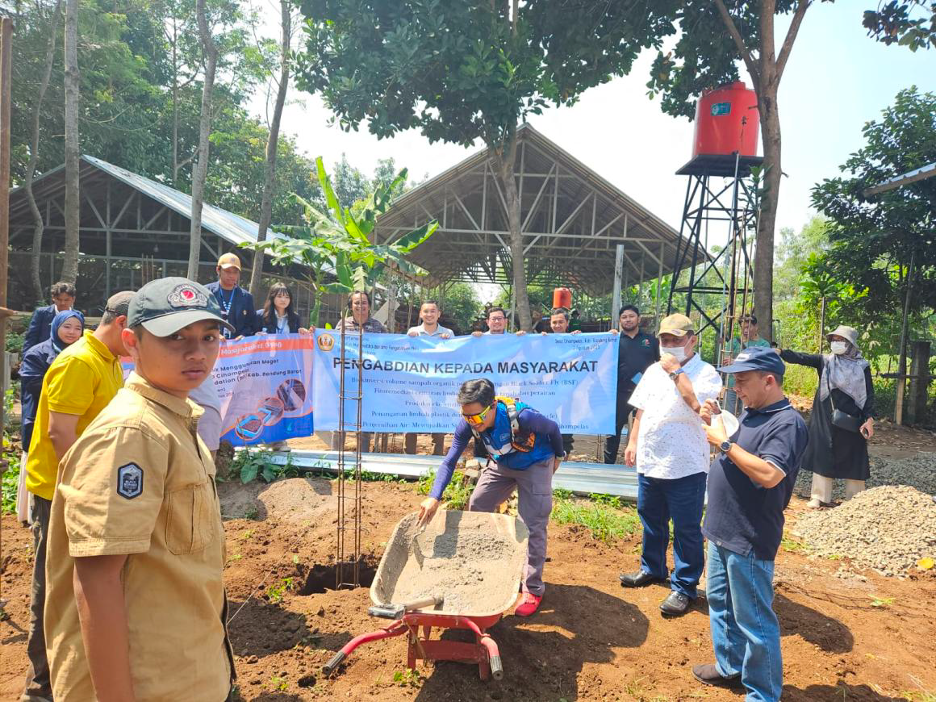
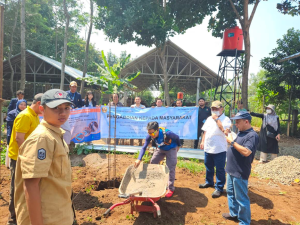
To improve environmental quality and the economic welfare of the community, On Saturday, 2 August 2025, Department of Chemistry, Faculty of Mathematics and Natural Sciences, Universitas Padjadjaran initiated a Community Service (PKM) program with the theme “Bioconversion of Organic Waste Using Maggots in Desa Cihampelas, Kabupaten Bandung Barat”
Activities are included not only a community outreach and education, but also a construction of galvanized chicken coops for laying hens:
- Community outreach and education
- Utilizing maggot pupae shells as a liquid organic fertilizer to improve the quality of agricultural produce.
Fermentation experiments were conducted using EM4 and molasses solutions for 10 days under anaerobic conditions, and the fermentation results were evaluated based on physical and chemical indicators such as aroma, color, and the degree of decomposition of the material. The results of this program demonstrated that the resulting liquid fertilizer was of good quality with characteristics suitable for improving soil fertility and stimulating plant growth. The implementation of this simple technology not only added value to waste management but also supported the increase in the productivity of previously suboptimal agricultural land. Through training local farmers, this program contributed to improving community knowledge and skills and opening new economic opportunities through the production and distribution of fertilizers based on maggot pupae shell waste. This program also serves as a model for implementing environmentally friendly solutions based on innovation that can be replicated in various regions.
- Diversification of kasgot into organic fertilizer products as a supplement to growing media to increase agricultural productivity.
Experiments were conducted on making kasgot fertilizer with the addition of burnt rice husks and granulated sugar, as well as product marketing strategies through innovative packaging and digital promotions. The results of these activities demonstrate that kasgot fertilizer has high potential as an environmentally friendly and economical organic fertilizer alternative. Furthermore, marketing kasgot fertilizer can increase the financial independence of BSF and strengthen the economy of the surrounding community.
- Construction of galvanized chicken coops for laying hens:
The maggots cultivated by BSF are used as animal feed (laying hens). BSF currently has two 7×23 m chicken coops with a population of 3,000 hens. This population produces 150 kg of eggs per day. With the government’s Free Nutritious Feeding program, demand for chicken eggs has skyrocketed. In response, BSF felt the need to increase the number of laying hens, hoping that increased egg sales would improve the welfare of its employees, residents of Desa Cihampelas. The construction of these coops is in line with the increase in the volume of maggots used as chicken feed.
The galvanized battery coop will be constructed measuring 7×23 meters with a capacity of 1,600 hens. Construction of the coops began with the driving of the poles on August 2, 2025. The coops are expected to be completed in October.
From the activities that have been carried out, it is hoped that programs related to waste processing can continue to develop and provide long-term benefits for the people of Desa Cihampelas and provide a good example for other villages in managing organic waste productively
06/Kim/2025