

Forecasting ASEAN Tourist Arrivals to Indonesia with a Hybrid SSA-SVM Model


Tourism is one of Indonesia’s economic pillars, contributing significantly to national revenue, job creation, and overall growth. Among international visitors, travelers from ASEAN countries make up one of the largest groups, making it essential to understand their travel patterns.
A recent study published in the Geojournal of Tourism and Geosites titled “Forecasting the Number of ASEAN Tourists to Indonesia with the Hybrid Singular Spectrum Analysis-Support Vector Machine Method” was conducted by Hutabarat et al (2025) from the Department of Statistics, Universitas Padjadjaran.
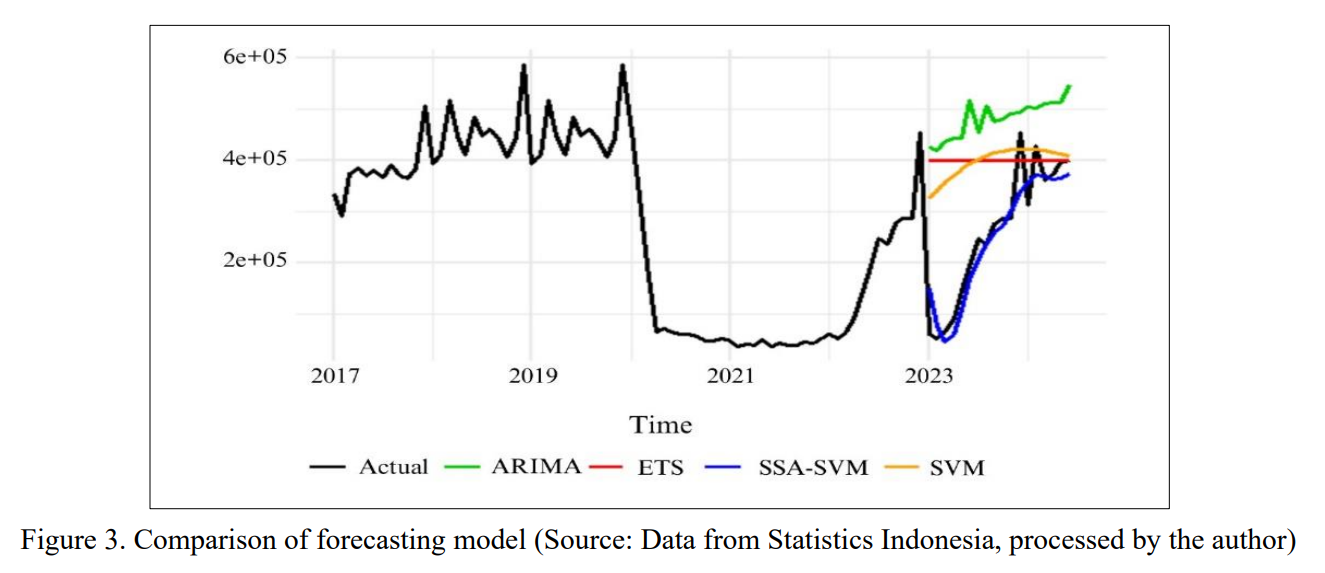
The research applies a Hybrid Singular Spectrum Analysis-Support Vector Machine (SSA-SVM) model to forecast the number of ASEAN tourists visiting Indonesia. Using monthly time-series data from January 2017 to June 2024 provided by the Badan Pusat Statistik (BPS), the method decomposes data into trend, seasonality, and noise components before applying SVM for forecasting—capturing complex patterns often missed by traditional models.
The results show that the SSA-SVM model outperformed ARIMA, Exponential Smoothing, and standalone SVM, achieving exceptionally low error rates:
- MAPE: 0.220%
- MAE: 33,274.64
- RMSE: 43,716.18
With this high accuracy, SSA-SVM proves to be a reliable tool for projecting ASEAN tourist arrivals. The findings offer valuable insights for policymakers and tourism stakeholders, from optimizing resource allocation to designing targeted marketing strategies.
Beyond its technical contribution, this research also supports the United Nations Sustainable Development Goals (SDGs):
- SDG 8 (Decent Work and Economic Growth): promoting a tourism sector that drives inclusive economic growth.
- SDG 9 (Industry, Innovation, and Infrastructure): advancing innovation through machine learning applications.
- SDG 12 (Responsible Consumption and Production): fostering more efficient and sustainable tourism management.
By leveraging data-driven and machine learning approaches, this Unpad study opens new opportunities for adaptive, precise, and sustainable tourism policies in Indonesia.
Source: https://www.scopus.com/record/display.url?eid=2-s2.0-105007802194&origin=resultslist
13/Stat/2025