

Garlic Utilization to Produce Natural Pesticides


By Natural Products Chemistry and Synthesis Laboratory, Department of Chemistry, Faculty of Mathematics and Natural Sciences, Universitas Padjadjaran
Sumedang, Friday, 19 July 2024
Contributes to the following SDGs:
#SDGs2 #SDG3 #SDGs4 #SDGs8 #SDGs11 #SDGs15
Food production targets continue to increase each year. In 2020, the Ministry of Agriculture targeted increased food production compared to the previous year. The Minister of Agriculture stated that the rice production target was 59.15 million tons, corn 30.35 million tons, and soybeans 1.29 million tons. However, these production targets are often hampered by various factors, including attacks by Plant Pest Organisms (OPT). The threat of POT continues to occur annually, such as in July 2005, when a brown planthopper attack on the northern coast of Java devastated at least 10,644 hectares of rice crops in Cirebon Regency. Of these, 419 hectares were declared crop failures (Ministry of Agriculture, 2020).
Pest development is influenced by climate factors, both directly and indirectly. Temperature, relative humidity, and photoperiod directly influence the life cycle, lifespan, and diapause ability of insects.
The widespread infestation of plant pests often leads farmers to control them using chemical pesticides. However, farmers often violate regulations by using chemical pesticides in doses that exceed the recommended dosage.
The improper or excessive use of pesticides can result in poisoning and even death. The World Health Organization (WHO) estimates that there are approximately 25 million cases of chemical pesticide poisoning each year, or approximately 68,493 cases per day. Pesticides are highly toxic to humans, so the safety of pesticide use must be a priority.
Given the numerous negative effects of chemical pesticide use, effective and safer alternatives to chemical pesticides are needed. One alternative to chemical pesticides is the use of botanical pesticides based on natural ingredients. Botanical pesticides are pesticides whose active ingredients are derived from plants or other readily available organic materials that are effective in controlling pests and plant diseases without polluting the environment, one of which is garlic.
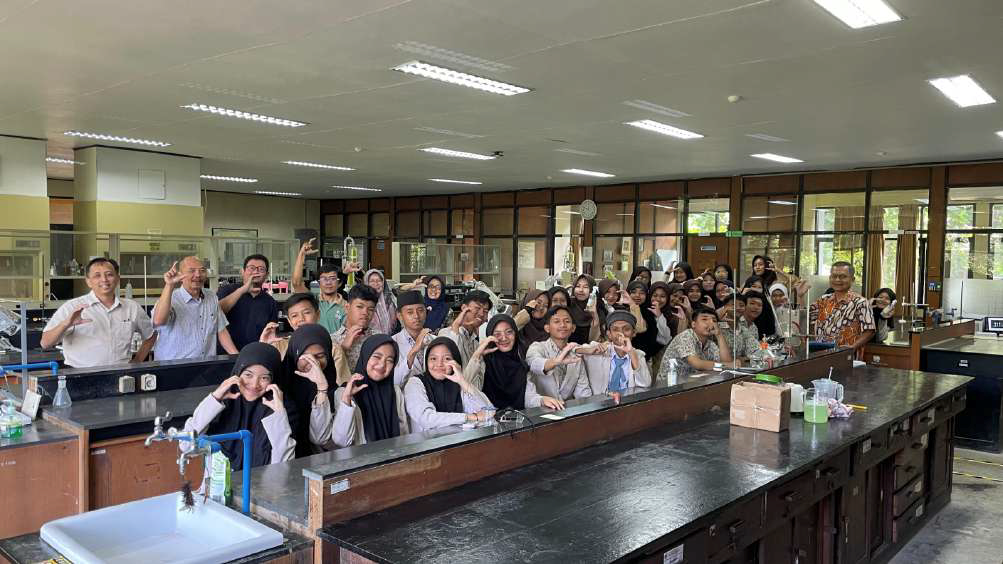
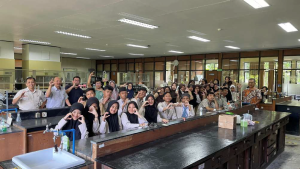
Based on the explanation above, community service activities were conducted (lead by Kindi Farabi, M.Si., PhD), including outreach in the form of presentations on natural pesticides from garlic and hands-on practice by students of MA Darul Hufadz-Cipacing in making safe and effective garlic-based pesticides.
The community service method for students at MA Darul Hufadz-Cipacing was carried out through several stages:
- A brief explanation of chemical and botanical pesticides, including their definition, function, types, and impacts, including the use of natural botanical pesticides and the use of garlic in these natural pesticides.
- A live demonstration of the process of making natural pesticides from garlic, including the packaging process.
Natural Pesticide from Garlic
In this stage, students listened to explanations and witnessed firsthand the process of making a natural pesticide, guided by the PLP and students.
23/Kim/2025