

Mapping Clean Water and Sanitation in West Java with Advanced Clustering Analysis
Access to clean water and sanitation is a cornerstone of public health and sustainable development. Yet, understanding regional disparities often requires more than raw statistics—it calls for advanced analytical methods that can uncover hidden patterns.
A recent article in Communications in Mathematical Biology and Neuroscience, titled “Dependency-based Clustering Using Correspondence and Ward’s Hierarchical Analysis: A Case Study on Clean Water and Sanitation Indicators in West Java’s Cities and Regencies”, presents such an approach. The study was conducted by Nauli et. al (2025)
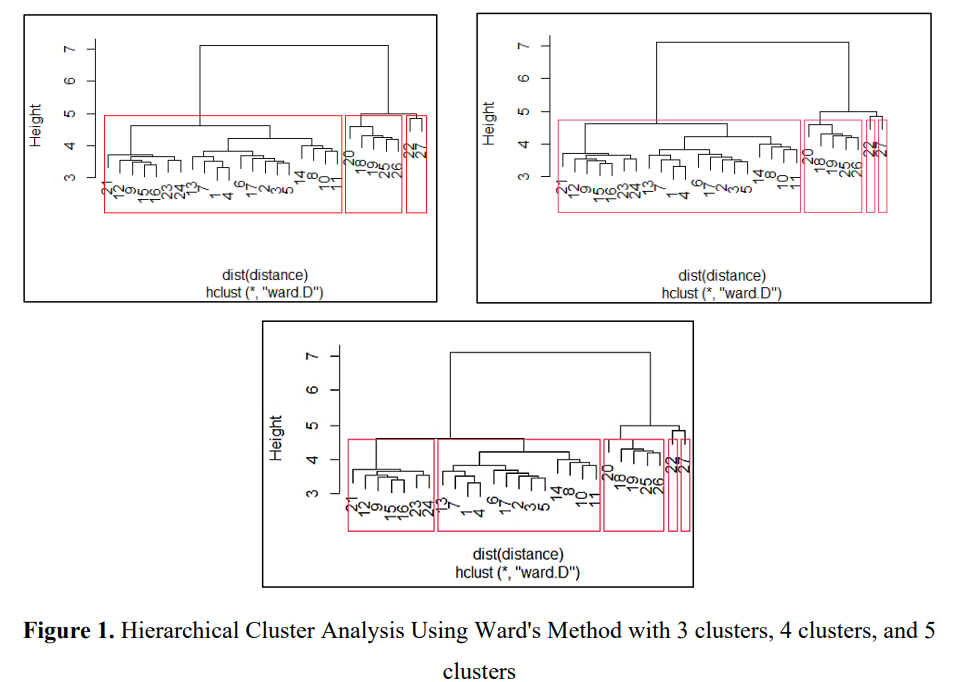
The research combines Multiple Correspondence Analysis (MCA) with Ward’s Hierarchical Clustering to examine clean water and sanitation indicators across districts and cities in West Java Province. While MCA is effective in identifying patterns in categorical data, it often struggles to capture sufficient variance in only two dimensions. To address this, the authors extended their analysis to 63 dimensions using Euclidean distance matrices, ensuring that 100% of the variance was retained.
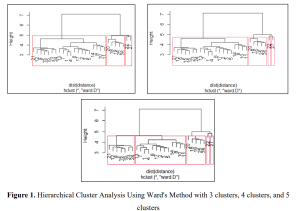
By doing so, the team achieved a more comprehensive characterization of each region and successfully grouped them into 18 clusters with similar clean water and sanitation profiles. Among several clustering methods tested, Ward’s method provided the most consistent and interpretable results. The analysis also explored scenarios with three, four, and five clusters, reflecting the realities of government budget allocation for regional development.
Beyond its methodological contribution, the study holds strong policy implications. By identifying regional clusters with shared challenges, policymakers can design more targeted interventions, allocate resources efficiently, and monitor progress effectively.
The research also supports the United Nations Sustainable Development Goals (SDGs), particularly:
- SDG 6 (Clean Water and Sanitation): ensuring universal access to safe and affordable water.
- SDG 9 (Industry, Innovation, and Infrastructure): leveraging advanced analytics for smarter planning.
- SDG 11 (Sustainable Cities and Communities): addressing urban-rural disparities in essential services.
With its innovative blend of statistical techniques and real-world application, this study demonstrates how data-driven insights can help governments achieve sustainable improvements in public health infrastructure.
Source: https://www.scopus.com/record/display.url?eid=2-s2.0-105007309723&origin=resultslist
14/Stat/2025