

Mathematical Modeling of Ride-Hailing Matching Considering Uncertain User and Driver Preferences: Interval-Valued Fuzzy Approach




A team of international researchers led by Sudradjat Supian (Universitas Padjadjaran, Indonesia), together with Subiyanto Subiyanto, Sisilia Sylviani, Tubagus Robbi Megantara, Abdul Talib Bon (Universiti Tun Hussein Onn Malaysia), and Vasile Preda (University of Bucharest, Romania), has developed a mathematical model for improving ride-hailing matching systems by accounting for uncertain user and driver preferences through an interval-valued fuzzy approach.
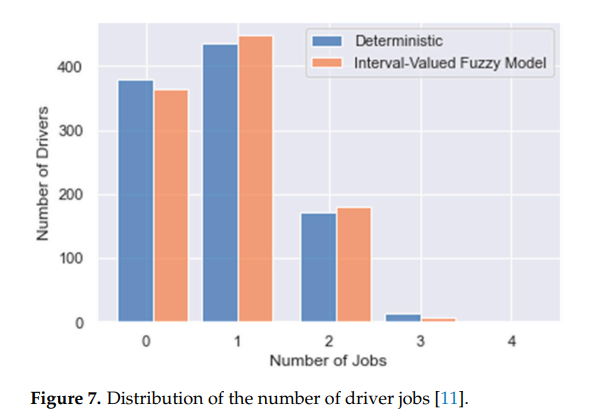
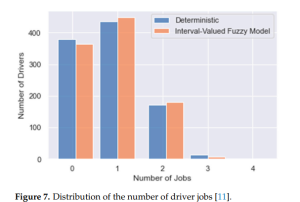
The problem studied is that current ride-hailing platforms often face inefficiencies in matching passengers with drivers due to uncertainty in preferences—such as route choices, waiting times, and service expectations. Traditional deterministic models fail to adequately capture this uncertainty, leading to mismatches, dissatisfaction, and reduced system efficiency.
To address this, the researchers applied interval-valued fuzzy sets, a method that better represents uncertain and imprecise preferences. Their model simulates and analyzes how ride-hailing platforms can optimize matching by considering both users’ and drivers’ varying needs and uncertainties.
The study concludes that this fuzzy-based mathematical framework significantly improves matching accuracy and system fairness, leading to more efficient ride-hailing services and higher satisfaction for both users and drivers.
This research also contributes to several United Nations Sustainable Development Goals (SDGs):
- SDG 9 (Industry, Innovation, and Infrastructure): by fostering innovative approaches in transportation systems.
- SDG 11 (Sustainable Cities and Communities): by enhancing urban mobility efficiency and accessibility.
- SDG 12 (Responsible Consumption and Production): by optimizing transport resource use.
- SDG 17 (Partnerships for the Goals): through strong collaboration between Indonesian, Malaysian, and Romanian institutions.
Overall, this work demonstrates how mathematical modeling and fuzzy logic can help create smarter, more adaptive, and sustainable ride-hailing systems in today’s rapidly growing urban environments.
10/Mat/2025