

Modeling, Simulation, and Backstepping Control of a Chaotic Monetary System
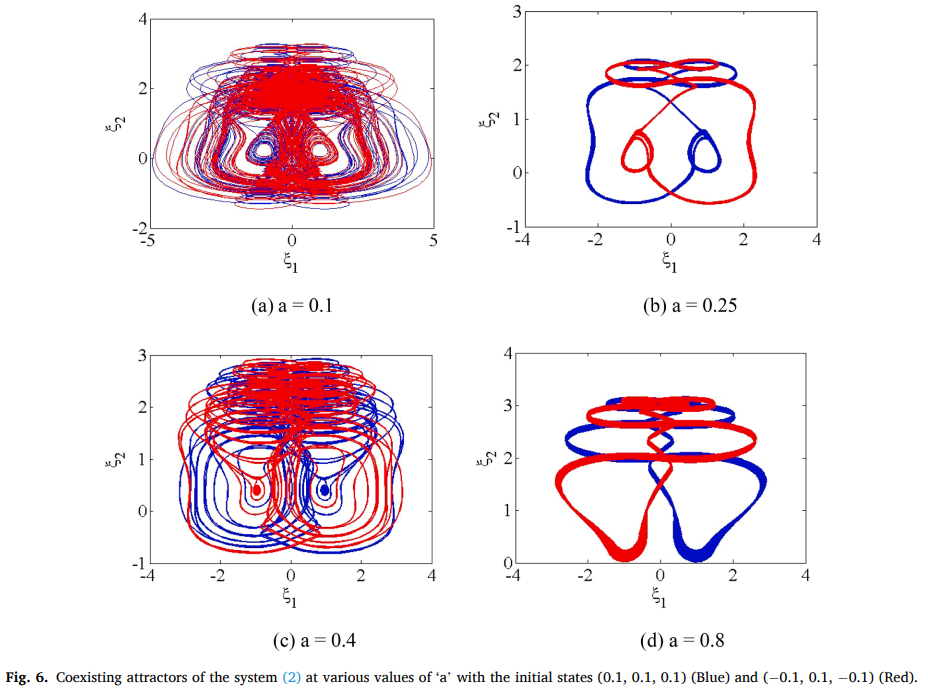



A team of international researchers led by Muhamad Deni Johansyah from Universitas Padjadjaran, Indonesia, together with collaborators from Malaysia, India, Iran, and Bank Indonesia, has developed and analyzed a new chaotic monetary system that displays complex financial behaviors such as transient chaos and multistability.
The problem addressed in this research is the inability of traditional linear models to capture the unpredictable, nonlinear dynamics of real-world financial systems. Sudden market shifts, recessions, or inflationary spikes are difficult to explain with conventional approaches, making it necessary to explore nonlinear and chaotic models.
The authors propose a new autonomous nonlinear model of a monetary system. Through mathematical modeling, dynamic simulations, and the use of bifurcation diagrams and Lyapunov Exponents, the study reveals how the system can transition between chaotic, periodic, and stable states. Key mechanisms introduced include offset boosting and amplitude control, which allow researchers to manipulate chaotic signals and increase the system’s flexibility. Finally, the team applies a nonlinear backstepping control method to stabilize chaotic behavior and guide the system toward desired equilibrium points.
The conclusion of the study shows that this new model provides deeper insights into how complex financial systems behave under nonlinear dynamics. The proposed control methods successfully stabilize the system and demonstrate potential applications in economic policy-making and financial risk management.
In terms of global impact, the research aligns with several Sustainable Development Goals (SDGs):
- SDG 8 (Decent Work and Economic Growth): improving financial stability and resilience.
- SDG 9 (Industry, Innovation, and Infrastructure): applying innovative mathematical tools for robust economic modeling.
- SDG 17 (Partnerships for the Goals): showcasing collaboration between institutions across multiple countries to address complex financial challenges.
This work highlights how advanced mathematics and nonlinear control can support sustainable economic systems in an increasingly uncertain financial world.
01/Mat/2025