

Onoceranoid Triterpenes of Lansium domesticum Corr. cv. Kokossan and Their Cytotoxicity against MCF-7 Breast Cancer Cells
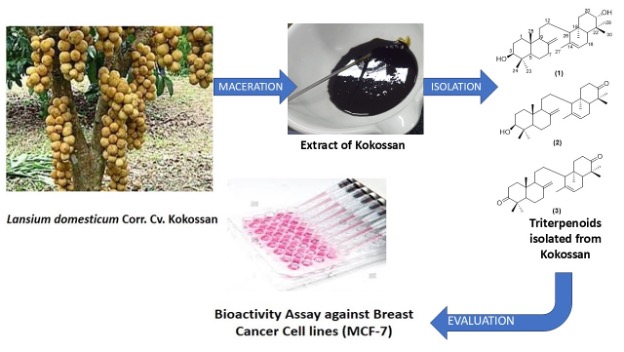

The onoceranoid triterpenes isolated from the kokossan fruit peels were studied in vitro using MCF-7 breast cancer cells. Three onoceranoids, namely 8,14-secogammacera-8(26),14-dien–3,21-diol (1), 3β-hydroxyonocera-8(26),14-dien-21-one (2) and α,γ-onoceradienedione (3), were obtained from the ethyl acetate extract of kokossan fruit peels. Compounds 1 – 3 were obtained for the first time from this cultivar. Several spectroscopic methods, including IR, HR-TOFMS and 1,2 D-NMR, were used to determine the chemical structures of compounds (1 – 3), and the results were compared to spectrum data that had previously been published. Additionally, the activity of compounds 1 – 3 was assessed in vitro using MCF-7 cells. With an IC50 value of 17.11 µg/mL, compound 2 demonstrated the highest activity in the activity test findings, followed by compounds 3 and 1, with IC50 values of 19.66 and > 150 µg/mL, respectively. When compared to cisplatin as a positive control, compounds 2 and 3 showed considerable potency, while compound 1 showed no activity. Compounds 2 and 3 were the most promising candidates for the anticancer drug; nevertheless, more testing is necessary to ascertain their biological mechanism for future research.
Contributes to the following SDGs:
Access to document: https://doi.org/10.48048/tis.2025.9000
By Mayanti et al.
Department of Chemistry, Faculty of Mathematics and Natural Sciences, Universitas Padjadjaran, Sumedang 45363, Indonesia.
#UnpadResearch #GoodHealthandWellBeing #SDGs3 #Kokossan #BreastCancer
09/Kim/2025