

Optimization of Metal Ion Concentration in Yeast Extract-Peptone Medium For Enhanced Bioethanol Fermentation using Response Surface Methodology
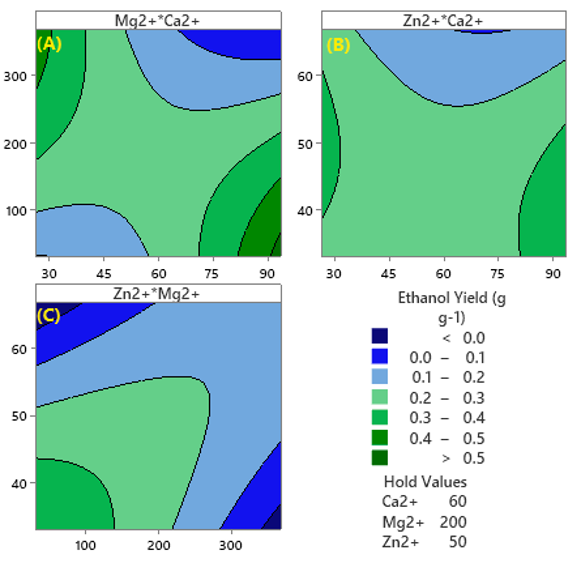

Bioethanol is a renewable eco-friendly alternative energy source produced by fermenting simple sugars using Saccharomyces cerevisiae. However, stress factors during fermentation can reduce yeast efficiency. Optimizing the metal ion supplementation in the growth medium is one strategy to mitigate these effects and improve ethanol yield. The present study was aimed to determine the optimal concentrations of calcium, magnesium, and zinc ions for maximizing ethanol production. Fermentation was carried out in yeast extract-peptone (YEP) medium supplemented with these metal ions. Optimization was conducted using response surface methodology with a central composite design (RSM-CCD). The experimental steps included yeast cell rejuvenation, media preparation, starter culture development, and fermentation. Optimal concentrations of calcium, magnesium, and zinc were 26.36, 368.18, and 66.82 mg L⁻¹, respectively. Under these conditions, the predicted ethanol yield was 0.567 g g⁻¹, while the validation experiment produced 0.274 ± 0.018 g g⁻¹. This represents a 20.7% increase compared as to the center point (0.274 vs 0.227 g g⁻¹). Although optimization enhanced ethanol yield, further refinement of fermentation conditions and medium composition is needed to reduce the gap between predicted and experimental values and to improve overall fermentation performance
Contributes to the following SDGs:
Access to document: https://doi.org/10.48165/abr.2025.27.01.9
By Ishmayana et al.
Department of Chemistry, Faculty of Mathematics and Natural Sciences, Universitas Padjadjaran, Sumedang 45363, Indonesia.
Study Center of Sensor and Green Chemistry, Faculty of Mathematics and Natural Sciences, Universitas Padjadjaran, Bandung 40132, Indonesia.
#UnpadResearch #AffordableandCleanEnergy #SDGs7 #Bioethanol #Fermentation
08/Kim/2025