

Smarter Spatiotemporal Forecasting: Guiding Better Predictions for Health, Climate, and Society
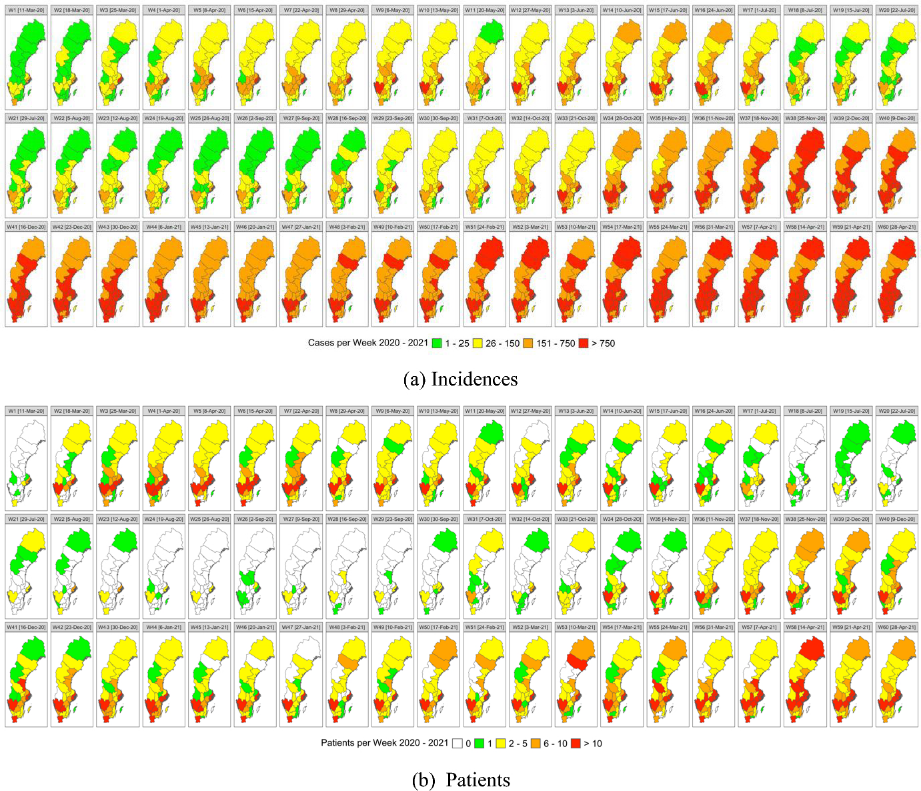

In a world where data is central to decision-making, predicting future events—whether related to public health, climate, or economics—remains a complex challenge. A new study sheds light on how different forecasting models perform when data is influenced by confounding factors, offering practical guidance for scientists and policymakers. The paper, titled “Spatiotemporal forecasting models with and without a confounded covariate” written by Jaya and Folmer (2025), discusses the performance of advanced forecasting models for different types of data.
The study analyzes the prediction accuracy of multivariate and univariate spatiotemporal models using both theoretical considerations and Monte Carlo simulations. The framework is based on a Bayesian latent Gaussian Markov random fields approach, applied to three generalized additive prediction models:
- A multivariate model with a spatiotemporally confounded covariate,
- A univariate model with spatiotemporal random effects and their interactions,
- A full multivariate model combining both approaches.
Key findings of the study include:
- For all types of response variables (count, binary, and continuous), the univariate and full multivariate models consistently outperform the multivariate model in terms of prediction accuracy (measured by mean-squared prediction error).
- For discrete variables, the univariate model outperforms the full multivariate model.
- For continuous variables, the full multivariate model is superior when confoundedness is low, but the univariate model is better when confoundedness is high.
These results provide important guidelines for practitioners and researchers in selecting the most suitable spatiotemporal forecasting model depending on the type of data and the level of covariate confounding.
This publication contributes not only to methodological advancements in Bayesian forecasting models, but also to practical applications in fields such as geography, environmental studies, and spatial statistics. It also supports the achievement of the Sustainable Development Goals (SDGs) by enhancing data-driven decision making, particularly in areas related to SDG 9 (Industry, Innovation, and Infrastructure) and SDG 11 (Sustainable Cities and Communities)
Source: https://www.scopus.com/record/display.url?eid=2-s2.0-85217385721&origin=resultslist
06/Stat/2025