




A research team led by Bertho Tantular and Yudhi Andriyana from Universitas Padjadjaran, Indonesia, along with Budi Nurani Ruchjana (Universitas Padjadjaran) and Anneleen Verhasselt (Ghent University, Belgium), developed a space-time varying coefficient model to analyze longitudinal data of dengue fever cases in Bandung City.
The problem studied is that dengue fever continues to be a critical public health issue in Indonesia, with cases showing significant variation across neighborhoods and over time. Standard statistical models struggle to fully capture the spatial and temporal heterogeneity of the disease, which limits targeted prevention strategies.
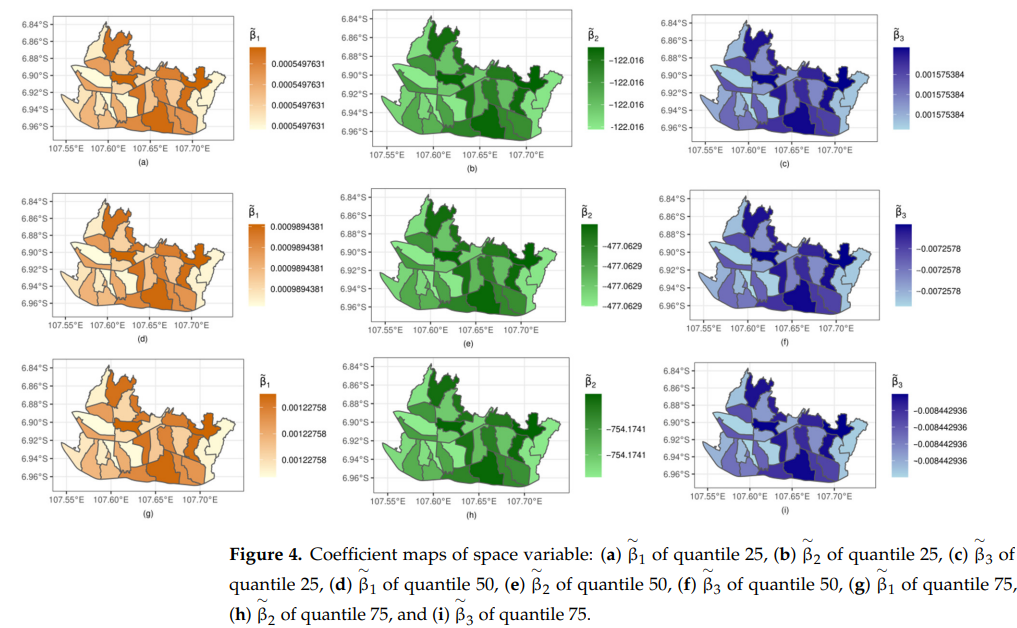
To address this, the authors applied a space-time varying coefficient model, allowing the influence of risk factors to shift dynamically across both space and time. By analyzing longitudinal dengue data from Bandung, they revealed spatial hotspots and temporal trends, providing a more precise understanding of the disease’s evolution.
The study concludes that this modeling approach is effective in identifying where and when dengue risks are highest, supporting policymakers in designing targeted, data-driven intervention strategies.
This work also contributes to several United Nations Sustainable Development Goals (SDGs):
- SDG 3 (Good Health and Well-Being): by strengthening public health tools to control vector-borne diseases.
- SDG 11 (Sustainable Cities and Communities): by making urban health management more effective.
- SDG 13 (Climate Action): by linking dengue dynamics to climate-sensitive factors.
- SDG 17 (Partnerships for the Goals): through collaboration between Indonesian and international researchers.
Overall, the study demonstrates how advanced statistical methods can provide actionable insights to reduce the public health burden of dengue fever in urban areas.
08/Mat/2025