

Spatial Interpolation of Rainfall Intensity In Java Island Using Ordinary Kriging
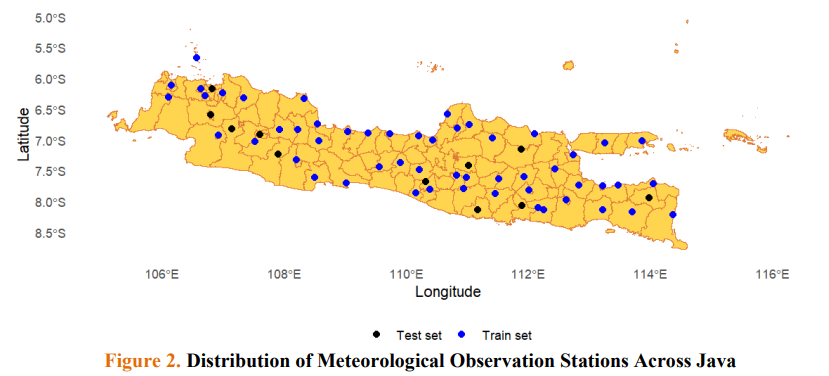
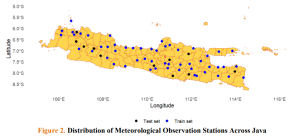
A team of researchers from Universitas Padjadjaran, Indonesia, including Epon Ningrum, Dwi Ispriyanti, and Sukono, has conducted a study on spatial interpolation of rainfall intensity in Java Island using the Ordinary Kriging method. The research provides new insights into rainfall distribution, which is essential for water resource management, agriculture, and disaster mitigation.
The problem addressed is that rainfall in Java Island is highly variable across space and time, making it difficult to measure and predict with accuracy. Limited observation stations further challenge the ability of policymakers and planners to obtain reliable rainfall distribution data for managing floods, droughts, and agricultural planning.
To solve this, the authors applied Ordinary Kriging, a geostatistical technique that estimates unknown values at unsampled locations based on spatial correlation of observed data. By applying this method, they generated rainfall intensity maps that provide a more accurate representation of spatial rainfall patterns across the island.
The study concludes that Ordinary Kriging is effective in estimating rainfall distribution, offering better accuracy than traditional interpolation methods. The resulting maps can help stakeholders improve water resource planning, agricultural productivity, and disaster preparedness in Java Island.
This research also contributes to several United Nations Sustainable Development Goals (SDGs):
- SDG 13 (Climate Action): strengthening adaptation and resilience to climate-related events.
- SDG 11 (Sustainable Cities and Communities): providing better rainfall data for disaster risk reduction.
- SDG 2 (Zero Hunger): supporting sustainable agriculture through improved water resource management.
- SDG 15 (Life on Land): aiding environmental conservation by understanding rainfall’s role in ecosystems.
Overall, this study demonstrates how geostatistical methods like Ordinary Kriging can improve environmental data analysis and support sustainable development in regions vulnerable to climate variability.
07/Mat/2025