

The Development of Fractional Black–Scholes Model Solution Using the Daftardar-Gejji Laplace Method for Determining Rainfall Index-Based Agricultural Insurance Premiums
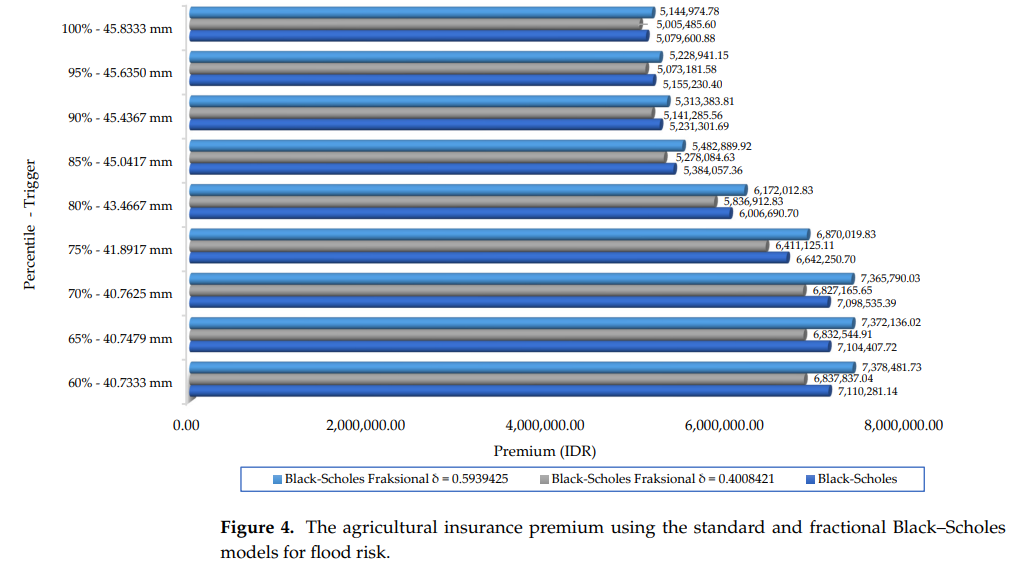



A team of researchers from Universitas Padjadjaran, Indonesia—Astrid Sulistya Azahra, Muhamad Deni Johansyah, and Sukono—has developed a novel approach for determining rainfall index-based agricultural insurance premiums using a fractional Black–Scholes model solved with the Daftardar-Gejji Laplace method.
The problem addressed is that agriculture, especially in tropical countries like Indonesia, is highly vulnerable to rainfall variability, which directly affects crop yields. Conventional insurance models often fail to capture the complexity and uncertainty of rainfall risks, leading to premiums that may not reflect actual farmer needs or climate conditions.
To address this gap, the researchers applied the fractional Black–Scholes model, a mathematical tool originally designed for financial markets, and solved it with the Daftardar-Gejji Laplace method for efficiency and accuracy. This model allows for a more precise determination of insurance premiums based on rainfall indices, providing better risk protection for farmers.
The study concludes that the proposed method offers a more reliable and fair calculation of agricultural insurance premiums, supporting farmers against rainfall-related risks while promoting financial sustainability for insurance providers.
This research also contributes to several United Nations Sustainable Development Goals (SDGs):
- SDG 2 (Zero Hunger): by supporting food security through risk protection for farmers.
- SDG 13 (Climate Action): by building resilience against climate variability.
- SDG 9 (Industry, Innovation, and Infrastructure): through innovative applications of financial mathematics in agriculture.
- SDG 17 (Partnerships for the Goals): by linking mathematics, climate science, and agricultural policy.
Overall, this study highlights how advanced mathematical models can strengthen agricultural resilience and provide innovative solutions to challenges posed by climate change.
11/Mat/2025