

Tiny Nanoparticles, Big Impact: Advancing Magnetoresistance for Future Technologies and Sustainable Innovation
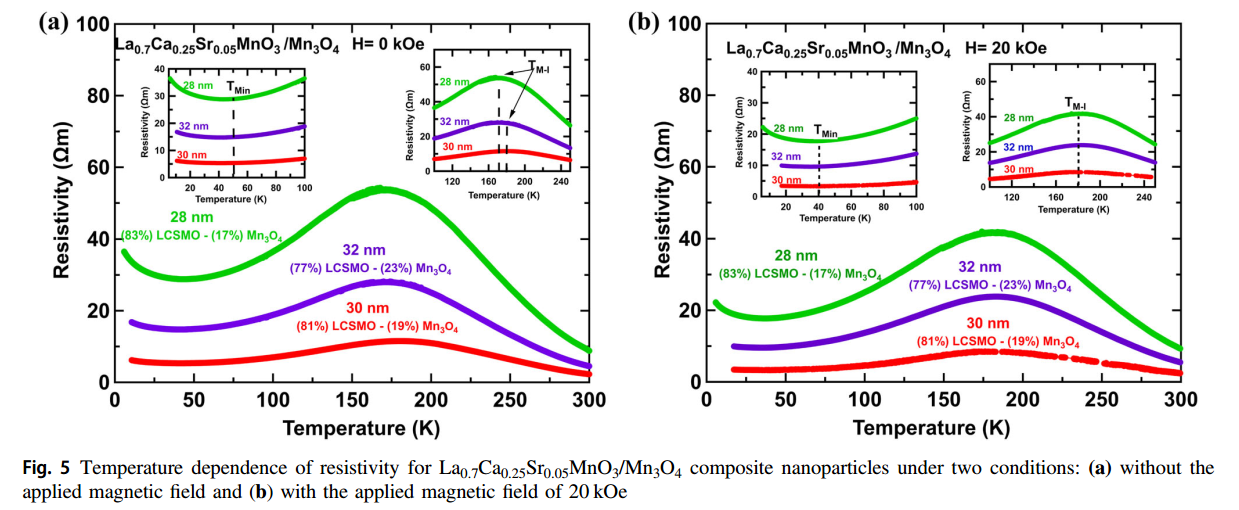


Clean energy technologies and advanced electronics are moving a step forward thanks to new research on nanoparticles with enhanced low-field magnetoresistance (LFMR). A team of scientists has successfully synthesized a composite material, La0.7Ca0.25Sr0.05MnO3/Mn3O4, that shows remarkable transport and magnetic properties at the nanoscale.
The researchers created these nanoparticles, measuring just 28–32 nanometers, using the sol-gel method and tested them at different sintering temperatures (700–900 °C). Their findings revealed that adjusting particle size and the fraction of Mn3O4 significantly impacts how the material conducts electricity and responds to magnetic fields.
One of the standout results was an LFMR value of up to 30% at low temperatures, a performance higher than many similar systems studied before. This improvement comes from the delicate balance of structural phases, grain boundaries, and conduction bandwidths inside the composite material. Interestingly, when the particles reached around 30 nanometers with 19% Mn3O4 content, they exhibited the best conductivity due to reduced grain boundary effects.
These insights are not just theoretical. Materials with improved magnetoresistance can contribute to energy-efficient devices, such as magnetic sensors, memory storage systems, and spintronic technologies. Such advances align with:
- SDG 7 (Affordable and Clean Energy): By paving the way for more efficient electronic and energy technologies.
- SDG 9 (Industry, Innovation, and Infrastructure): By driving innovation in advanced materials that can strengthen future industrial applications.
The study also opens doors for further exploration, particularly regarding unique electron scattering behaviors at very low temperatures. While more research is needed, this work demonstrates how nanoscience can unlock new possibilities for sustainable technology and smarter energy use.
Source: https://www.scopus.com/record/display.url?eid=2-s2.0-85210566390&origin=resultslist
23/Fis/2025