

Unpad Statistics Faculty Members Develop Multidimensional Analysis Method, Supporting SDGs through Regional Characterization


The article “Characterization method for more than three dimensions based on dependence and correlation using hybrid multiple correspondence analysis” has been published in the international journal Communications in Mathematical Biology and Neuroscience (2025) by Pratiwi et al. from the Department of Statistics, Faculty of Mathematics and Natural Sciences, Universitas Padjadjaran.
This study introduces an innovative approach to analyzing regional characteristics with interdependent qualitative and quantitative variables. The method applies Multiple Correspondence Analysis (MCA) combined with cosine correlation, enabling the analysis of datasets with multiple categories and more than three dimensions.
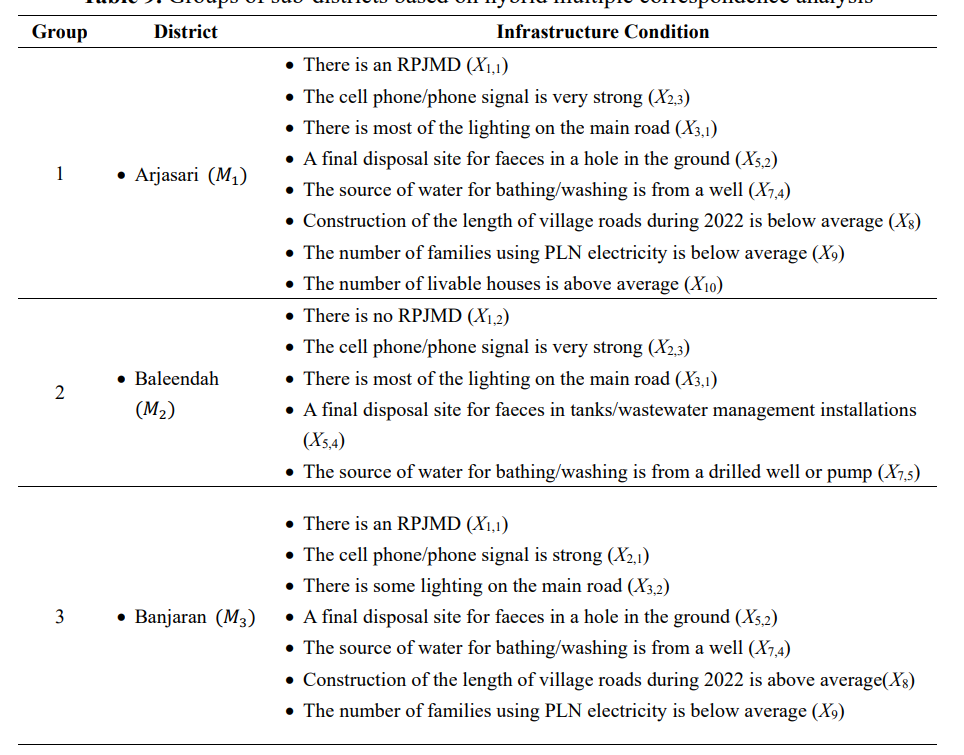
Using data from the 2023 Supporting Area Survey of Bandung Regency, which included eight qualitative variables (49 categories) and three quantitative variables, the study found that the cumulative variance in two dimensions was only 16.9%. To achieve 100% cumulative variance, a 43-dimensional Euclidean distance matrix was applied, leading to the identification of 28 district groups with distinct characteristics.
The findings contribute directly to the Sustainable Development Goals (SDGs), particularly:
- SDG 11 (Sustainable Cities and Communities): supporting sustainable urban and regional development planning.
- SDG 9 (Industry, Innovation, and Infrastructure): advancing innovative statistical methods for policy-making.
- SDG 17 (Partnerships for the Goals): strengthening collaboration and data-driven decision-making in development.
This research highlights the role of advanced statistical modeling in guiding more accurate and sustainable regional planning, in line with global development goals.
Source: https://www.scopus.com/record/display.url?eid=2-s2.0-85217222194&origin=resultslist
11/Stat/2025