

Utilization of nanohydroxyapatite-kaolin composites as a slow-release materials of urea
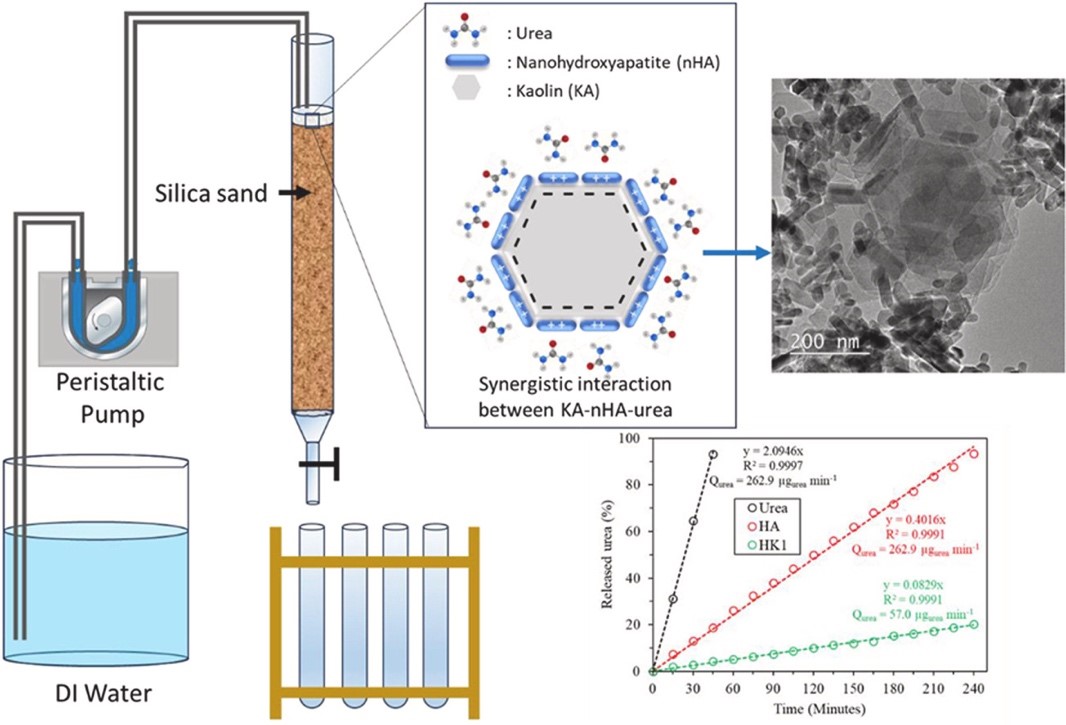


Urea is widely used as a nitrogen-source fertilizer in agriculture, but its leaching due to rainwater leads to eutrophication and environmental pollution. To address this, urea was incorporated into nanohydroxyapatite (nHA)–kaolin (KA) composites (HKs) that were synthesized via a two-step hydrothermal method as a slow-release materials (SRMs). Among the composites, HK1 (nHA:KA 75:25) is the most promising slow-release material with a urea release rate of 57.0 μgurea min−1 (20.3 % for 240 min), which is 4.6 times slower than urea release rate of nHA-urea for 262.9 μgurea min−1 (93.5 %, 240 min). This enhanced slow-release behavior is attributed to synergistic interactions between nHA and KA, as reflected on their zeta potentials. These findings suggest that HKs are promising slow-release materials for improving fertilizer efficiency and mitigating environmental impact in agricultural applications.
Contributes to the following SDGs:
#SDGs2 #SDGs13 #SDGs15
Access to document: https://doi.org/10.1016/j.matchemphys.2025.130976
By Noviyanti et al.
Department of Chemistry, Faculty of Mathematics and Natural Sciences, Universitas Padjadjaran, Sumedang 45363, Indonesia.
#UnpadResearch #ZeroHunger #SDGs2 #ClimateAction #SDGs13 #LifeonLand #SDGs15 #Hydroxyapatite #NitrogenFertilizer #Urea #Agricultural
12/Kim/2025