
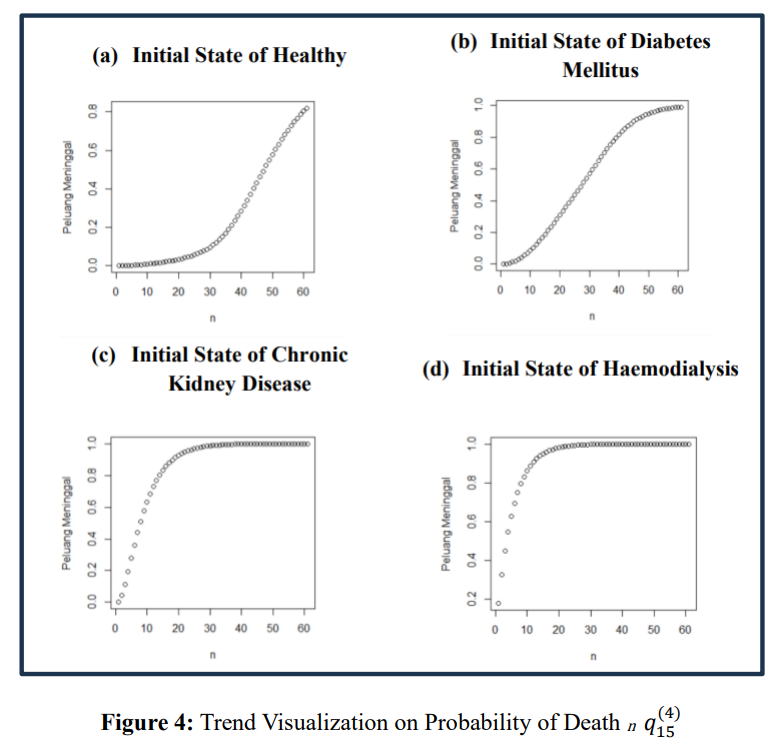


Health insurance plays a crucial role in protecting families from unexpected medical costs. A recent study explores how mathematics, specifically Markov chains, can make health insurance premiums fairer and more accurate.
The research focuses on estimating net premiums for term-health insurance by considering the probability of people developing serious illnesses such as diabetes mellitus, chronic kidney disease, or requiring hemodialysis. By modeling five possible health states—healthy, diabetes, chronic kidney disease, hemodialysis, and death—the study shows how health risks evolve over time.
One of the key findings is that the older a person is when entering insurance, the higher the premium they must pay. This happens because the probability of facing severe illness increases with age. For example, in the study’s case of a 56-year-old man taking a 20-year insurance plan, the calculations showed significantly higher annual premiums compared to younger entry ages.
The research highlights how using Markov chain models helps insurance companies:
- Accurately calculate risks and premiums based on health transitions.
- Justify premium differences between younger and older clients.
- Improve underwriting processes by emphasizing the importance of background health checks before enrollment.
This innovation is directly connected to the United Nations Sustainable Development Goal (SDG) 3: Good Health and Well-being. By making health insurance more reliable and data-driven, it ensures fairer access to healthcare protection and encourages more people to secure financial safety nets against critical illnesses.
In short, the study proves that mathematics is not only about numbers—it can help design smarter health systems and support better lives.
Source: https://scik.org/index.php/cmbn/article/view/8580
Stat-04/24