

Green Hydrogen Breakthrough: Ni-Mo Bimetal Electrode Boosts Clean Energy Future

A team of researchers has developed a highly effective and affordable method to produce green hydrogen, a clean fuel that could play a key role in the world’s transition to sustainable energy. Their work directly supports UN Sustainable Development Goal (SDG) 7: Affordable and Clean Energy and SDG 13: Climate Action.
Hydrogen, often called the “fuel of the future,” can be produced through water splitting. However, one major challenge has been the high cost and low durability of the electrodes used in the hydrogen evolution reaction (HER). This new study introduces a promising solution: a thin-film electrode made from a bimetal system of nickel (Ni) and molybdenum (Mo), fabricated using a scalable magnetron sputtering technique.
The researchers discovered that when the optimal ratio of Ni to Mo (6:1) is used, the electrode achieves extremely low energy losses, or “overpotentials,” of just 39 and 172 millivolts at different current densities. This means the electrode can generate hydrogen more efficiently and with less wasted energy compared to conventional materials.
Even more impressively, the electrode showed stable performance during long-term tests, operating for up to 100 hours under demanding conditions in both alkaline solutions and natural seawater. The seawater tests are especially promising, as they suggest the technology could be applied in real-world, large-scale hydrogen production without relying solely on purified water.
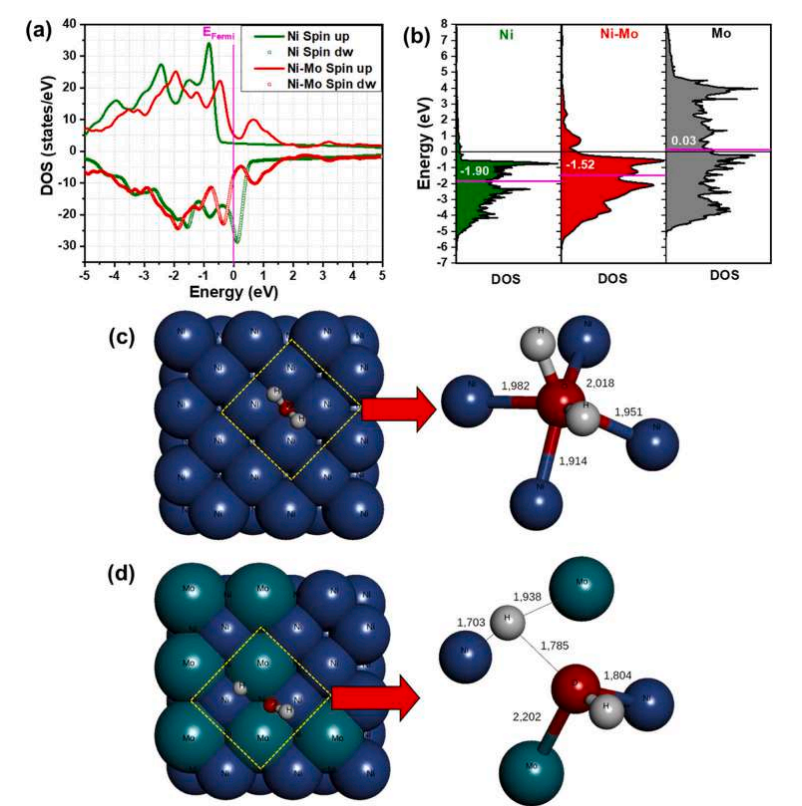
The success of the Ni-Mo electrode lies in how the addition of molybdenum fine-tunes the electronic structure of nickel. This adjustment enhances electron density and reduces the energy needed for hydrogen formation, making the reaction faster and more efficient.
By combining experimental results with computational modeling, the study provides solid proof that scalable sputtering technology can deliver practical, cost-effective, and durable electrodes for green hydrogen production.
As the world races toward decarbonization, innovations like this Ni-Mo system bring us closer to realizing hydrogen as a clean, widely available energy source. This breakthrough not only makes hydrogen more affordable but also supports the global effort to combat climate change.
Source: https://www.sciencedirect.com/science/article/abs/pii/S0925838824019935
Fis-01/24