

Smarter Rainfall Prediction for a Resilient Future: New Model Helps Tackle Climate Challenges in Java
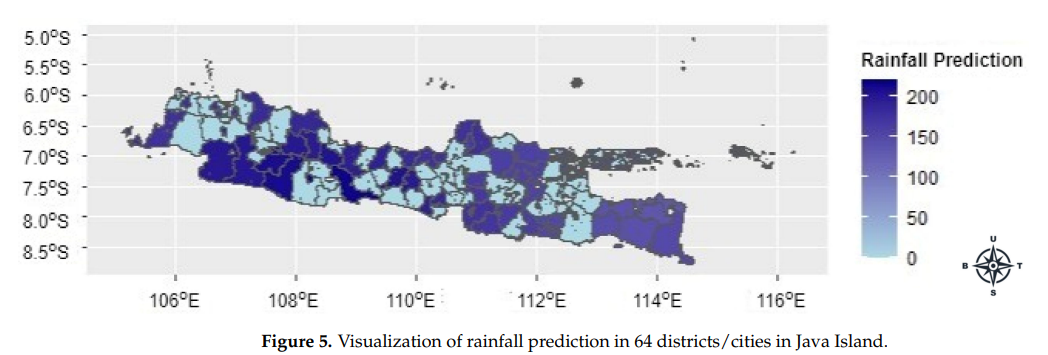
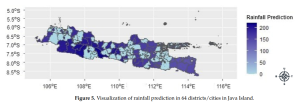
Rainfall is more than just weather—it shapes agriculture, daily life, and disaster preparedness, especially in Indonesia, one of the countries most vulnerable to climate change. A recent study has introduced an advanced way to predict rainfall patterns on Java Island, using the Spatial Durbin Model (SDM) with Casetti’s expansion approach.
This innovative method doesn’t just look at rainfall alone but considers how different climate factors—like air temperature, humidity, solar irradiation, and surface pressure—interact across regions. By analyzing spatial dependencies between these variables, the model provides far more accurate rainfall predictions, reaching an impressive accuracy rate of 97.22% (MAPE 2.78%).
🔹 Why is this important?
Java Island, home to over 150 million people, depends heavily on predictable rainfall for agriculture and daily needs. Yet, changing climate patterns often bring floods, droughts, and other extreme events. With this new model, agencies such as BMKG (Meteorology, Climatology, and Geophysics Agency) and agribusiness companies can make better decisions on disaster risk mitigation, planting seasons, and agricultural planning. Even the general public can benefit from clearer information about when and where rain will fall.
The research uses data from NASA POWER, applying a Knowledge Discovery in Databases (KDD) framework and a user-friendly RShiny web application. This makes the approach not only scientifically rigorous but also practical and accessible for real-world use.
🔹 Link to Sustainable Development Goals (SDGs):
- SDG 13 (Climate Action): By improving climate prediction, this research helps communities prepare for extreme weather.
- SDG 2 (Zero Hunger): Accurate rainfall forecasts support food security by optimizing agricultural cycles.
- SDG 11 (Sustainable Cities and Communities): Better climate data leads to stronger resilience in highly populated regions like Java.
The findings highlight a crucial point: rainfall patterns are never shaped by one factor alone, but by a complex interplay of multiple climate variables. Understanding these interactions can strengthen Indonesia’s fight against the impacts of climate change while safeguarding food security and community resilience.
In short, smarter rainfall prediction means stronger adaptation—and a safer, more sustainable future.
Source: https://www.mdpi.com/2227-7390/12/15/2304
Stat-08/24