

Smarter Ways to Handle Extreme Data: Simple Math for Big Impacts
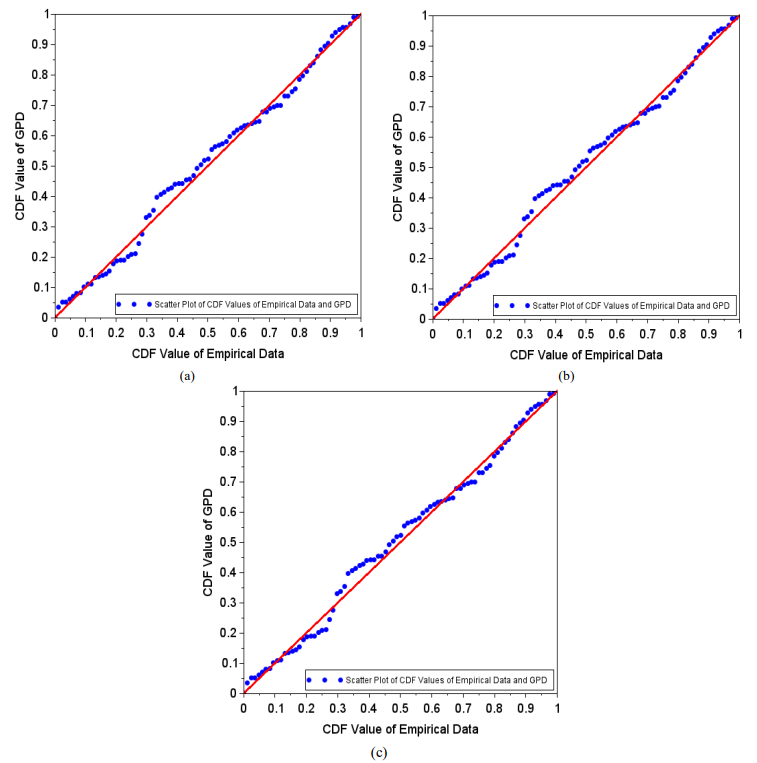


 In today’s world, extreme events—such as floods, financial crashes, or sudden climate shifts—are becoming more frequent and impactful. To prepare for them, researchers rely on advanced mathematical tools, including the Generalized Pareto Distribution (GPD), which helps model the probability of extreme events.
However, estimating GPD parameters is not easy. The traditional maximum likelihood method (ML) often runs into problems because the equations involved are complex and lack simple analytical solutions.
A recent study introduces a simpler and more practical approach: using fixed-point iteration, a straightforward numerical method that makes GPD parameter estimation much easier for both professionals and practitioners.
What the Research Found
- The researchers designed eight fixed-point iteration equations, then tested them for accuracy.
- Three equations passed the test, meeting both unbiasedness and convergence criteria.
- The method showed strong accuracy, with a Mean Absolute Percentage Error (MAPE) of 17%, and passed goodness-of-fit tests.
- This means practitioners can now estimate GPD parameters efficiently without needing overly complex computations.
Why This Matters
Extreme event modeling is crucial in many fields:
- Climate and disaster management (predicting floods, droughts, or extreme weather).
- Finance (assessing risks of sudden market crashes).
- Engineering and safety (designing systems resilient to rare but catastrophic failures).
By making parameter estimation easier, this research contributes to better decision-making and preparedness in high-risk situations.
Link to the SDGs
This study aligns with the United Nations Sustainable Development Goals (SDGs):
- SDG 9: Industry, Innovation, and Infrastructure – by providing innovative tools for data modeling in engineering and applied sciences.
- SDG 11: Sustainable Cities and Communities – by supporting risk management against natural and man-made disasters.
- SDG 13: Climate Action – by improving models that help predict and prepare for extreme climate events.
With this simple yet effective method, researchers, policymakers, and industry professionals gain a new tool to better understand and anticipate extremes. Smarter modeling means stronger preparedness and resilience, ensuring that societies can adapt more effectively to the uncertainties of the future.
Mat-10/24