

Turning Lignin Waste into Clean Energy: How Zeolite Catalysts Support Sustainable Fuel Development
A recent study has highlighted the critical role of zeolite catalysts in upgrading lignin bio-oil, a renewable energy source derived from biomass. The findings could open new pathways for producing cleaner and more sustainable fuels, supporting global efforts under the UN Sustainable Development Goals (SDGs), especially SDG 7: Affordable and Clean Energy and SDG 12: Responsible Consumption and Production.
From Lignin to Bio-Oil: The Challenge
Lignin, a natural polymer found in plant cell walls, can be converted into bio-oil through a process called pyrolysis. However, raw bio-oil faces several problems: it contains too much oxygen, is highly viscous, and unstable—making it unsuitable for direct use as fuel. To overcome this, scientists focus on catalytic upgrading, a refining step that improves its quality.
The Role of Constraint Index (CI) in Catalysts
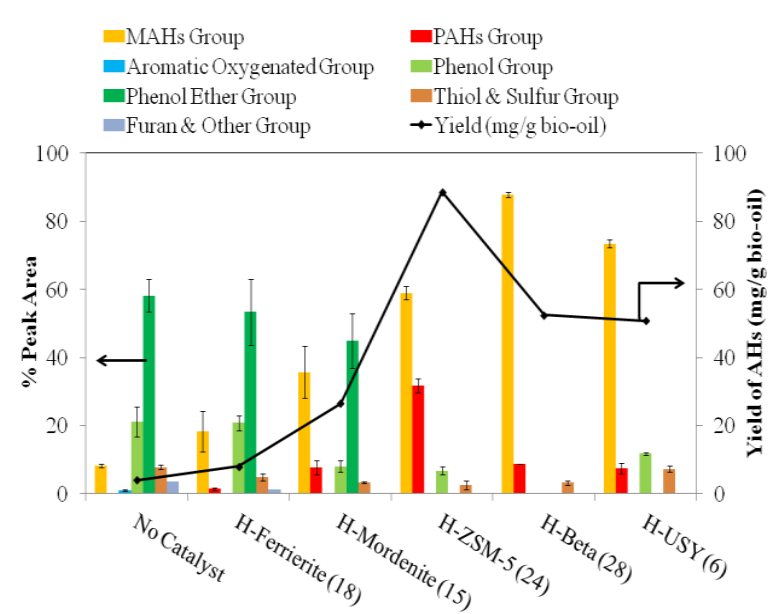
In this study, researchers tested five types of aluminum-rich zeolites—materials with tiny, structured pores that act as catalysts. The team discovered that the constraint index (CI), which measures how the pore structure influences chemical reactions, plays a key role in the refining process.
- High CI zeolites (such as H-ZSM-5) proved most effective, producing high yields of valuable aromatic hydrocarbons—a cleaner and more stable fuel component.
- Low CI zeolites (H-Mordenite, H-Beta, H-USY), with larger pores, allowed more coking (carbon buildup), which quickly deactivates the catalyst.
- Interestingly, H-Ferrierite, despite its high CI, performed poorly due to its narrow pore structure, showing that both pore size and channel design are crucial factors.
Why It Matters for Sustainability
The research highlights how fine-tuning catalyst design can enhance bio-oil upgrading, helping reduce dependence on fossil fuels. By making biofuels more efficient and practical, this innovation directly contributes to:
- SDG 7 (Affordable and Clean Energy): Supporting the development of renewable, cleaner energy sources.
- SDG 12 (Responsible Consumption and Production): Promoting sustainable use of biomass resources and reducing waste.
This breakthrough demonstrates that small-scale molecular properties, like pore size and constraint index, can have large-scale impacts on energy sustainability. By improving bio-oil upgrading, the study offers a step forward in transforming agricultural and forestry residues into practical, eco-friendly fuels.
Kim-01/24